Performance Marketing for Brands Scaling from ₹50L to ₹2Cr
Performance Marketing for Brands Scaling from ₹50L to ₹2Cr
Performance Marketing for Brands Scaling from ₹50L to ₹2Cr
A stage by stage breakdown of performance marketing for D2C brands scaling from ₹50L to ₹2Cr, covering budgets, metrics, team structure, and common mistakes at each phase.
A stage by stage breakdown of performance marketing for D2C brands scaling from ₹50L to ₹2Cr, covering budgets, metrics, team structure, and common mistakes at each phase.
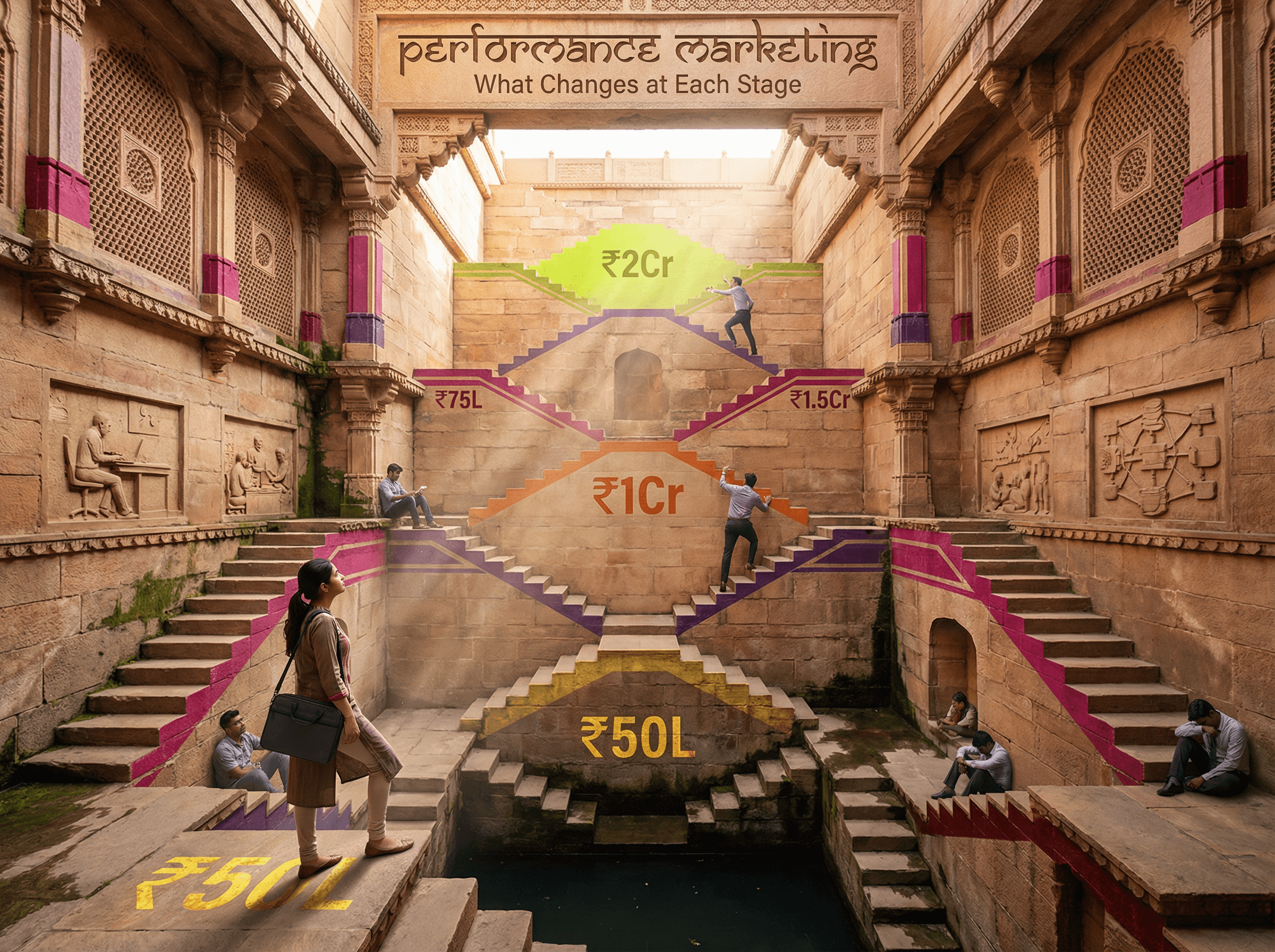
What Changes at Each Stage
What got you to ₹50 lakh will not get you to ₹2 crore.
Most D2C founders hit their first real wall somewhere between ₹60 and ₹75 lakh in monthly revenue. The scrappy tactics that worked early on start failing. Random creative testing. Manually tweaking ads. Posting whenever inspiration hits. Growth slows down. CAC starts rising. Effort increases but momentum drops.
The mistake most founders make is assuming scaling means doing more of the same.
It does not.
Scaling means changing how you think about marketing at every stage.
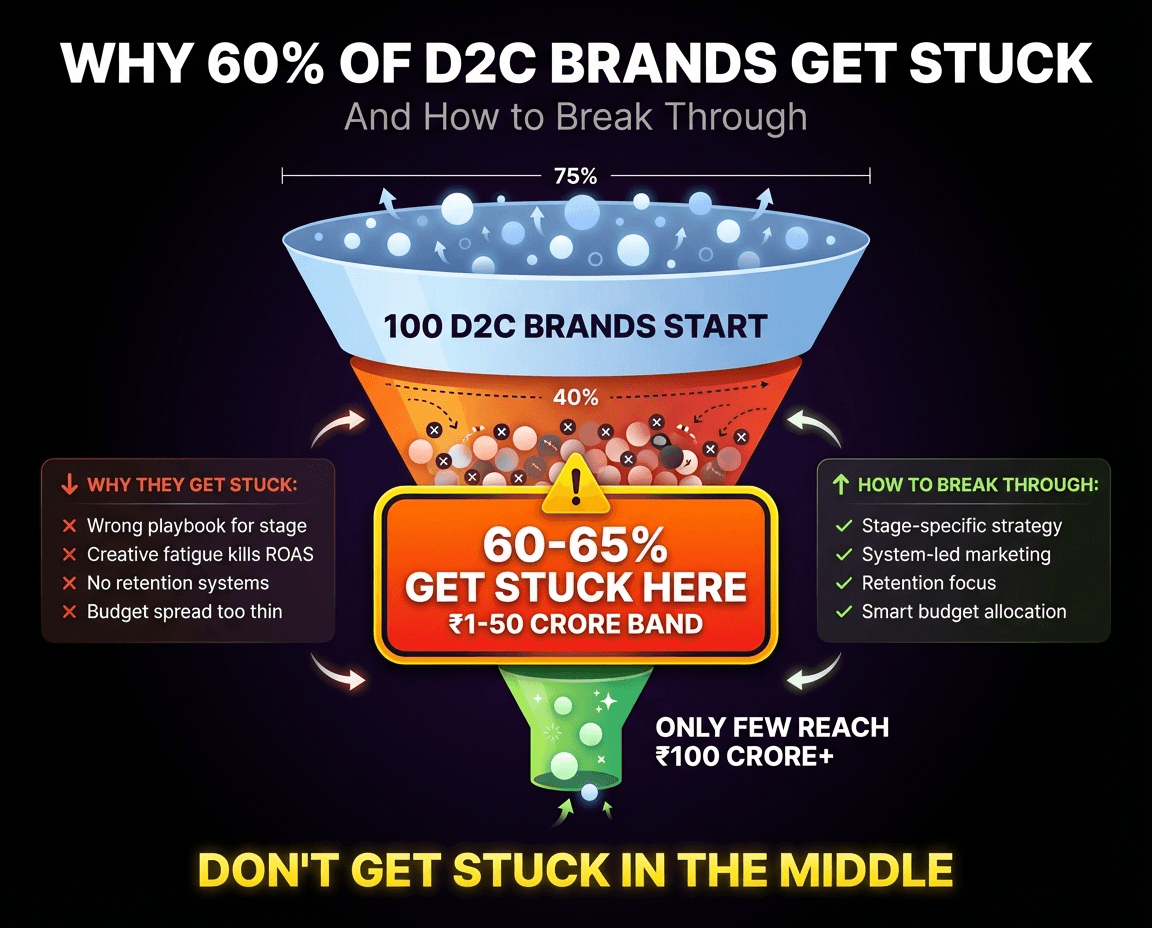
Research surveying more than 100 Indian D2C founders shows that most brands stay stuck between ₹1 and ₹50 crore in revenue, with very few crossing ₹100 crore. The issue is rarely product market fit. It is that founders do not adjust their marketing playbook as they grow.
This guide breaks down exactly how performance marketing changes between ₹50L and ₹2Cr. Budgets. Metrics. Team structure. And the mistakes that quietly kill growth.
Why This Framework Matters
Most performance marketing advice is built for extremes. Either early stage hustle or enterprise scale.
The ₹50L to ₹2Cr range is different.
You are too big to rely on guesswork. Boosting posts and hoping for the best stops working.
You are too small to afford bloated teams or expensive retainers.
Every rupee needs intention.
What changes as you scale:
• What you can afford to pay per customer
• How much lifetime value matters
• Which channels deserve budget
• How your team is structured
• How fast creative needs refreshing
• How complex attribution becomes
The brands that break through do not just spend more. They spend smarter.
Stage 1
₹50L to ₹75L
From Proof of Concept to Repeatable System
What Is Happening in the Business
Revenue exists but feels fragile. Some months spike. Others dip. Marketing still depends heavily on the founder. Testing is instinct-driven. Wins are not documented properly.
Performance Marketing Focus
Primary goal: find one channel that works and make it repeatable.
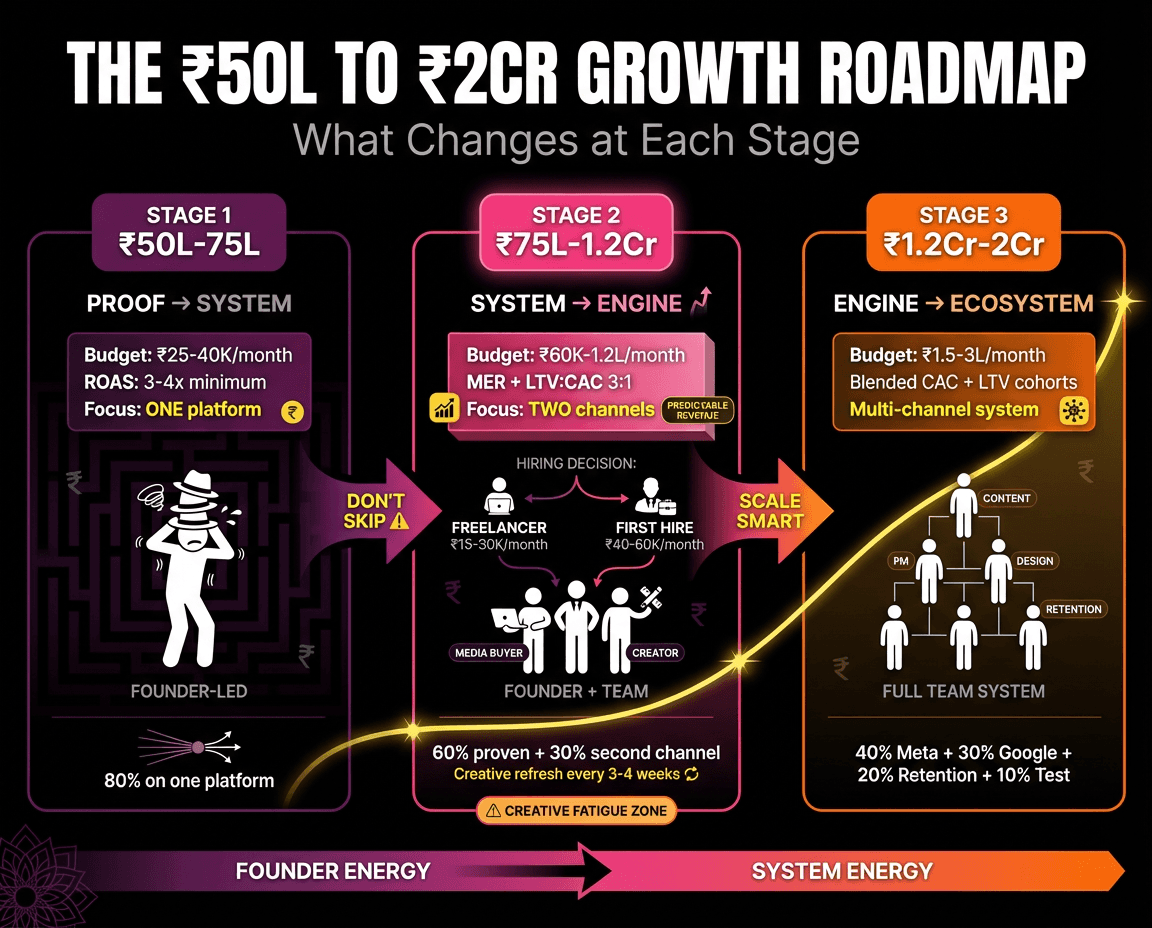
Ad Budget: ₹25k to ₹40k per month
Split it like this:
• 80% on one core platform
• 20% on testing
Trying five platforms with tiny budgets gives you no real data.
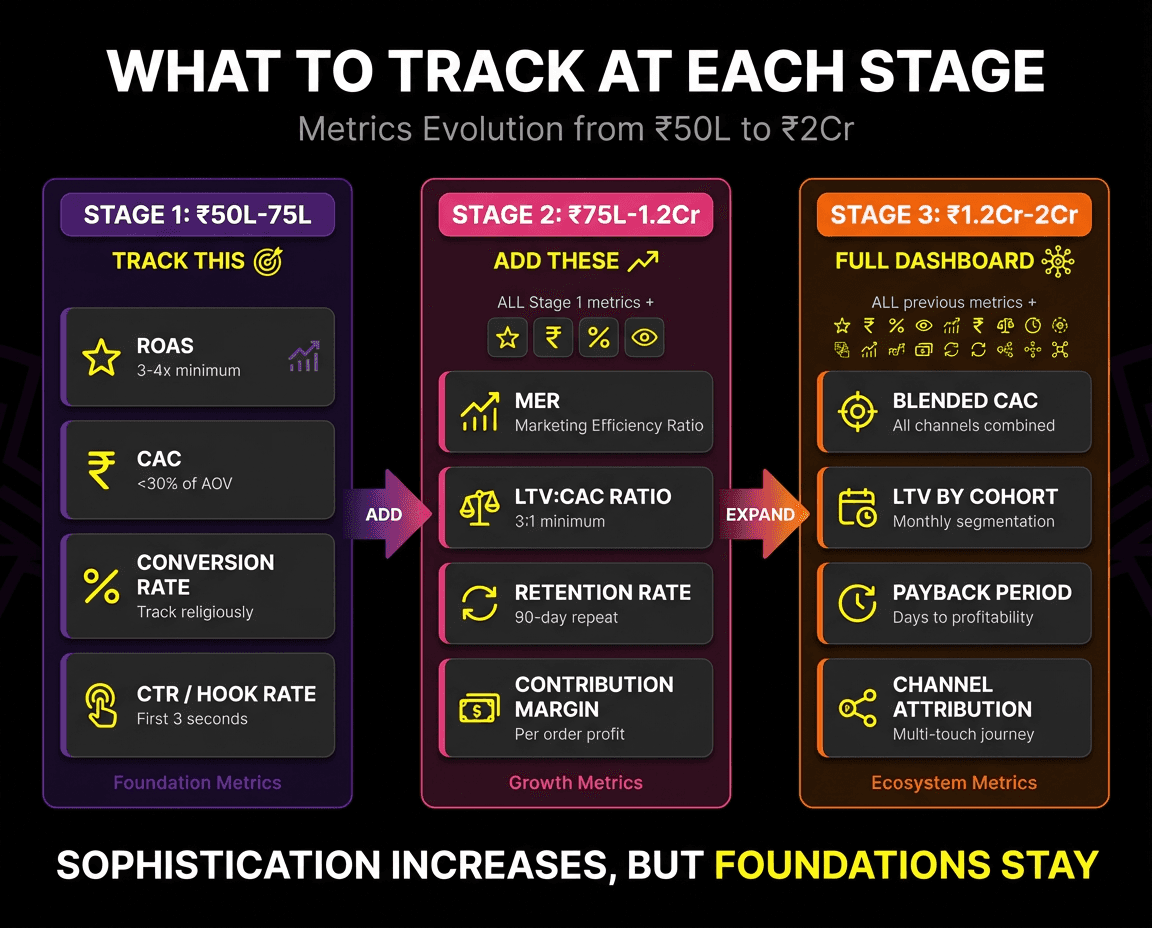
Metrics That Matter:
• ROAS of at least 3x
• CAC under 30% of AOV
• CTR and hook rate
• Conversion rate
Creative Approach:
• Founder-led content
• Customer reviews and UGC
• Simple testimonials
• Before-and-after visuals where applicable
Common Mistakes:
• Spreading budget too thin
• Celebrating impressions instead of sales
• Not tracking which creative actually converts
What You Should Be Doing
Document wins. Screenshot successful ads. Build a swipe file.
Set up basic retargeting. This alone can add 20-30% revenue.
Start collecting email and phone numbers. Retention begins here.
What Changes at Each Stage
What got you to ₹50 lakh will not get you to ₹2 crore.
Most D2C founders hit their first real wall somewhere between ₹60 and ₹75 lakh in monthly revenue. The scrappy tactics that worked early on start failing. Random creative testing. Manually tweaking ads. Posting whenever inspiration hits. Growth slows down. CAC starts rising. Effort increases but momentum drops.
The mistake most founders make is assuming scaling means doing more of the same.
It does not.
Scaling means changing how you think about marketing at every stage.
Research surveying more than 100 Indian D2C founders shows that most brands stay stuck between ₹1 and ₹50 crore in revenue, with very few crossing ₹100 crore. The issue is rarely product market fit. It is that founders do not adjust their marketing playbook as they grow.
This guide breaks down exactly how performance marketing changes between ₹50L and ₹2Cr. Budgets. Metrics. Team structure. And the mistakes that quietly kill growth.
Why This Framework Matters
Most performance marketing advice is built for extremes. Either early stage hustle or enterprise scale.
The ₹50L to ₹2Cr range is different.
You are too big to rely on guesswork. Boosting posts and hoping for the best stops working.
You are too small to afford bloated teams or expensive retainers.
Every rupee needs intention.
What changes as you scale:
• What you can afford to pay per customer
• How much lifetime value matters
• Which channels deserve budget
• How your team is structured
• How fast creative needs refreshing
• How complex attribution becomes
The brands that break through do not just spend more. They spend smarter.
Stage 1
₹50L to ₹75L
From Proof of Concept to Repeatable System
What Is Happening in the Business
Revenue exists but feels fragile. Some months spike. Others dip. Marketing still depends heavily on the founder. Testing is instinct-driven. Wins are not documented properly.
Performance Marketing Focus
Primary goal: find one channel that works and make it repeatable.
Ad Budget: ₹25k to ₹40k per month
Split it like this:
• 80% on one core platform
• 20% on testing
Trying five platforms with tiny budgets gives you no real data.
Metrics That Matter:
• ROAS of at least 3x
• CAC under 30% of AOV
• CTR and hook rate
• Conversion rate
Creative Approach:
• Founder-led content
• Customer reviews and UGC
• Simple testimonials
• Before-and-after visuals where applicable
Common Mistakes:
• Spreading budget too thin
• Celebrating impressions instead of sales
• Not tracking which creative actually converts
What You Should Be Doing
Document wins. Screenshot successful ads. Build a swipe file.
Set up basic retargeting. This alone can add 20-30% revenue.
Start collecting email and phone numbers. Retention begins here.
Stage 2
₹75L to ₹1.2Cr
From Repeatable System to Scalable Engine
What Is Happening in the Business
Revenue stabilizes. Cash flow improves. The first marketing hire becomes a real discussion. You are no longer guessing every month.
Performance Marketing Focus
Primary goal: scale what works and add a second channel deliberately.
Ad Budget: ₹60k to ₹1.2L per month
Split:
• 60% on proven channel
• 30% on second channel
• 10% on testing
Metrics That Matter:
• MER instead of only ROAS
• LTV to CAC ratio of at least 3:1
• Contribution margin per order
• Retention within 90 days
Creative Approach:
• Structured A and B testing
• Launch multiple creatives per campaign
• Build a creative library
• Refresh every 3 to 4 weeks
What Changes Here
Creative fatigue hits hard. What worked last month slows down.
Retargeting finally becomes profitable.
Email and WhatsApp marketing turn ROI positive.
Related read: Why Your Meta Ads Are Bleeding Money
Common Mistakes:
• Hiring too early
• Increasing spend without improving creative
• Ignoring retention
Stage 3
₹1.2Cr to ₹2Cr
From Scalable Engine to Multi Channel System
What Is Happening in the Business
Brand recognition begins. Customers tag you organically. Operations stabilize. You are thinking about profitability or fundraising.
Performance Marketing Focus
Primary goal: build an ecosystem, not just campaigns.
Ad Budget: ₹1.5L to ₹3L per month
Split:
• 40% on Meta
• 30% on Google
• 20% retention
• 10% experiments
Metrics That Matter:
• Blended CAC
• LTV by cohort
• Contribution margin after all costs
• Payback period under 90 days
• Multi touch attribution
Creative Approach:
• Brand plus performance creative
• Scaled UGC from micro creators
• Video first content
• Messaging tests, not just discounts
Related read: How We Build Social Media Systems
Stage 2
₹75L to ₹1.2Cr
From Repeatable System to Scalable Engine
What Is Happening in the Business
Revenue stabilizes. Cash flow improves. The first marketing hire becomes a real discussion. You are no longer guessing every month.
Performance Marketing Focus
Primary goal: scale what works and add a second channel deliberately.
Ad Budget: ₹60k to ₹1.2L per month
Split:
• 60% on proven channel
• 30% on second channel
• 10% on testing
Metrics That Matter:
• MER instead of only ROAS
• LTV to CAC ratio of at least 3:1
• Contribution margin per order
• Retention within 90 days
Creative Approach:
• Structured A and B testing
• Launch multiple creatives per campaign
• Build a creative library
• Refresh every 3 to 4 weeks
What Changes Here
Creative fatigue hits hard. What worked last month slows down.
Retargeting finally becomes profitable.
Email and WhatsApp marketing turn ROI positive.
Related read: Why Your Meta Ads Are Bleeding Money
Common Mistakes:
• Hiring too early
• Increasing spend without improving creative
• Ignoring retention
Stage 3
₹1.2Cr to ₹2Cr
From Scalable Engine to Multi Channel System
What Is Happening in the Business
Brand recognition begins. Customers tag you organically. Operations stabilize. You are thinking about profitability or fundraising.
Performance Marketing Focus
Primary goal: build an ecosystem, not just campaigns.
Ad Budget: ₹1.5L to ₹3L per month
Split:
• 40% on Meta
• 30% on Google
• 20% retention
• 10% experiments
Metrics That Matter:
• Blended CAC
• LTV by cohort
• Contribution margin after all costs
• Payback period under 90 days
• Multi touch attribution
Creative Approach:
• Brand plus performance creative
• Scaled UGC from micro creators
• Video first content
• Messaging tests, not just discounts
Related read: How We Build Social Media Systems
What Changes Now
Attribution becomes complex.
Content and SEO start compounding.
Influencer collaborations become viable.
First party customer data becomes your moat.
Team Evolution
Either:
• Small in house team plus agency support
or
• Fully in house team with higher costs
Both work if economics support them.
What Never Changes
Regardless of stage:
• Creative quality beats budget size.
• Understanding customers beats fancy tools.
• Retention is cheaper than acquisition.
• Testing never stops.
• Brand voice consistency builds trust.
The Real Risk
Skipping Stages
Trying to run a ₹2Cr playbook at ₹60L leads to:
• Over hiring
• Over complexity
• Budget fragmentation
You cannot skip foundations.
Founder Led vs System Led Marketing
Stage 1 depends on founder energy.
Stage 3 depends on systems.
This transition is uncomfortable but necessary. Growth stalls when everything needs founder approval.
Brands that scale build systems that work without them.
What Moh Maaya Would Ask You
• Which stage are you actually in?
• Where is your money going?
• What is your CAC vs LTV?
• When was creative last refreshed?
• What is repeat purchase rate?
Most brands fail because they run the wrong playbook for their stage.
What Changes Now
Attribution becomes complex.
Content and SEO start compounding.
Influencer collaborations become viable.
First party customer data becomes your moat.
Team Evolution
Either:
• Small in house team plus agency support
or
• Fully in house team with higher costs
Both work if economics support them.
What Never Changes
Regardless of stage:
• Creative quality beats budget size.
• Understanding customers beats fancy tools.
• Retention is cheaper than acquisition.
• Testing never stops.
• Brand voice consistency builds trust.
The Real Risk
Skipping Stages
Trying to run a ₹2Cr playbook at ₹60L leads to:
• Over hiring
• Over complexity
• Budget fragmentation
You cannot skip foundations.
Founder Led vs System Led Marketing
Stage 1 depends on founder energy.
Stage 3 depends on systems.
This transition is uncomfortable but necessary. Growth stalls when everything needs founder approval.
Brands that scale build systems that work without them.
What Moh Maaya Would Ask You
• Which stage are you actually in?
• Where is your money going?
• What is your CAC vs LTV?
• When was creative last refreshed?
• What is repeat purchase rate?
Most brands fail because they run the wrong playbook for their stage.
Sources:
• https://www.entrepreneurindia.com/blog/en/article/why-most-indian-d2c-brands-fail-to-cross-inr-100-crore-mark.58314
• https://www.socialee.in/ultimate-guide-to-high-roas-for-d2c-brands/
• https://spicetreedigital.com/blog/top-7-metrics-that-actually-matter-in-performance-marketing
• https://tzsdigital.com/what-performance-metrics-actually-matter-for-d2c-brands-in-2025/
• https://www.aanve.com/case-studies/d2c-roas-performance-max/
Sources:
• https://www.entrepreneurindia.com/blog/en/article/why-most-indian-d2c-brands-fail-to-cross-inr-100-crore-mark.58314
• https://www.socialee.in/ultimate-guide-to-high-roas-for-d2c-brands/
• https://spicetreedigital.com/blog/top-7-metrics-that-actually-matter-in-performance-marketing
• https://tzsdigital.com/what-performance-metrics-actually-matter-for-d2c-brands-in-2025/
• https://www.aanve.com/case-studies/d2c-roas-performance-max/
More Insights
More Insights

Let's Work Together
Have a project in mind? We’d love to hear about it. Let’s create something great together!
Let's Work Together
Have a project in mind? We’d love to hear about it. Let’s create something great together!
Let's Work Together
Have a project in mind? We’d love to hear about it. Let’s create something great together!