Our Marketing Agency Philosophy: Why We Named Ourselves Moh Maaya
Our Marketing Agency Philosophy: Why We Named Ourselves Moh Maaya
Our Marketing Agency Philosophy: Why We Named Ourselves Moh Maaya
Most marketing is illusion. At Moh Maaya Media, we believe good marketing builds honest illusions that create real value. Here's our marketing agency philosophy.
Most marketing is illusion. At Moh Maaya Media, we believe good marketing builds honest illusions that create real value. Here's our marketing agency philosophy.

Every time you scroll past a perfectly curated Instagram feed, see a “limited time offer,” or watch an influencer rave about a product, you are witnessing Moh Maaya in action.
The term comes from Hindi and Sanskrit and loosely translates to illusion or enchantment. It is the act of shaping desire, influencing perception, and building a version of reality that may or may not fully exist. And here is the uncomfortable truth that defines our marketing agency philosophy: all marketing is Moh Maaya.
Every brand you have ever loved has created an illusion around itself.
• Apple sells the feeling of creativity and innovation.
• Nike sells the belief of athletic greatness.
• Every D2C skincare brand sells the promise of flawless skin and confidence.
Here is where our philosophy becomes important. There is honest illusion, and there is deceptive illusion. One builds brands that last. The other destroys trust and disappears.
That is why we named ourselves Moh Maaya Media. Not because we celebrate deception, but because we acknowledge what marketing truly is. We are not pretending that authentic content is not carefully crafted, or that organic reach happens without strategy.
We create illusions. We just do it honestly.
What Moh Maaya Actually Means and Why It Guides Our Philosophy
In Indian philosophy, Moh Maaya represents the tension between desire and illusion. Moh refers to attachment or longing. Maaya refers to illusion or perceived reality.
Together, they describe how humans form emotional connections to things that are, at their core, constructed perceptions.
When we were naming the agency, most options felt dishonest. Names like Growth Lab or Digital Accelerators treated marketing like pure science. Names like Authentic Agency or Real Connect pretended marketing is not about shaping perception.
We wanted a name that admitted the truth.
Because here is what most agencies will never say out loud:
• They are not just telling your story.
• They are constructing a narrative.
• They are designing desire.
• They are shaping how people see your brand.
That is not wrong. That is simply marketing.
The real question is whether the perception you build aligns with what your brand actually delivers.
The Real Problem With Modern Marketing Agencies
Walk into most agency pitches and you will hear the same words repeated endlessly: authentic, transparent, genuine, real connection.
They promise viral content and organic growth as if these things appear by accident. As if every viral post was not studied, tested, and optimized. As if organic reach does not require precise timing, structure, and hooks.
The problem is not illusion. The problem is pretending illusion does not exist.
This creates a strange situation where agencies lie about not lying. They perform authenticity. And founders feel it immediately.
That is why so many D2C founders feel burned by past agency experiences.
• Authentic engagement promised, but only scheduled posts delivered.
• Viral content promised, but only trending audio with no brand relevance.
• Community building promised, but only follower count tracked.
• Partnership promised, but vendor behavior delivered.
This spray-and-pray approach fails because there is no strategic foundation. Just activity. Just illusion without substance.
Agencies compete on output volume instead of business outcomes. 30 posts per month becomes the selling point instead of revenue impact.
The result is busy brands, not growing businesses.
Related read: We Don’t Compete on Execution. Here’s What We Sell Instead
Every time you scroll past a perfectly curated Instagram feed, see a “limited time offer,” or watch an influencer rave about a product, you are witnessing Moh Maaya in action.
The term comes from Hindi and Sanskrit and loosely translates to illusion or enchantment. It is the act of shaping desire, influencing perception, and building a version of reality that may or may not fully exist. And here is the uncomfortable truth that defines our marketing agency philosophy: all marketing is Moh Maaya.
Every brand you have ever loved has created an illusion around itself.
• Apple sells the feeling of creativity and innovation.
• Nike sells the belief of athletic greatness.
• Every D2C skincare brand sells the promise of flawless skin and confidence.
Here is where our philosophy becomes important. There is honest illusion, and there is deceptive illusion. One builds brands that last. The other destroys trust and disappears.
That is why we named ourselves Moh Maaya Media. Not because we celebrate deception, but because we acknowledge what marketing truly is. We are not pretending that authentic content is not carefully crafted, or that organic reach happens without strategy.
We create illusions. We just do it honestly.
What Moh Maaya Actually Means and Why It Guides Our Philosophy
In Indian philosophy, Moh Maaya represents the tension between desire and illusion. Moh refers to attachment or longing. Maaya refers to illusion or perceived reality.
Together, they describe how humans form emotional connections to things that are, at their core, constructed perceptions.
When we were naming the agency, most options felt dishonest. Names like Growth Lab or Digital Accelerators treated marketing like pure science. Names like Authentic Agency or Real Connect pretended marketing is not about shaping perception.
We wanted a name that admitted the truth.
Because here is what most agencies will never say out loud:
• They are not just telling your story.
• They are constructing a narrative.
• They are designing desire.
• They are shaping how people see your brand.
That is not wrong. That is simply marketing.
The real question is whether the perception you build aligns with what your brand actually delivers.
The Real Problem With Modern Marketing Agencies
Walk into most agency pitches and you will hear the same words repeated endlessly: authentic, transparent, genuine, real connection.
They promise viral content and organic growth as if these things appear by accident. As if every viral post was not studied, tested, and optimized. As if organic reach does not require precise timing, structure, and hooks.
The problem is not illusion. The problem is pretending illusion does not exist.
This creates a strange situation where agencies lie about not lying. They perform authenticity. And founders feel it immediately.
That is why so many D2C founders feel burned by past agency experiences.
• Authentic engagement promised, but only scheduled posts delivered.
• Viral content promised, but only trending audio with no brand relevance.
• Community building promised, but only follower count tracked.
• Partnership promised, but vendor behavior delivered.
This spray-and-pray approach fails because there is no strategic foundation. Just activity. Just illusion without substance.
Agencies compete on output volume instead of business outcomes. 30 posts per month becomes the selling point instead of revenue impact.
The result is busy brands, not growing businesses.
Related read: We Don’t Compete on Execution. Here’s What We Sell Instead
Good Marketing Is Honest Illusion
Honest illusion means creating desire for something that genuinely delivers.
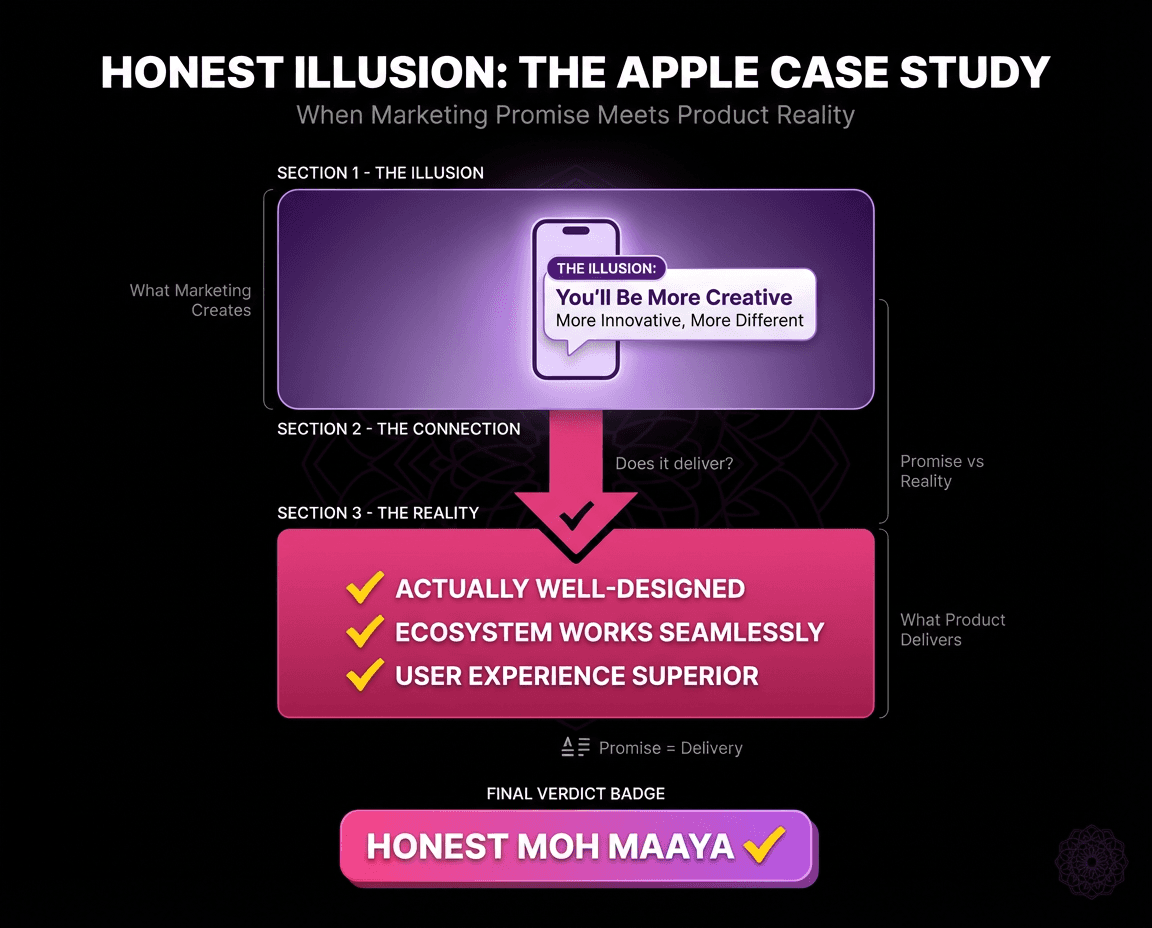
Take Apple. The marketing creates aspiration. The illusion suggests creativity and innovation. But the product experience backs it up.
• The design is genuinely thoughtful.
• The ecosystem works smoothly.
• The user experience feels superior.
The perception matches reality.
The same applies to Indian D2C brands like Minimalist or Dot & Key. Their marketing builds aspiration around clear, glowing skin. But the products use quality ingredients, transparent formulations, and real science.
That is honest illusion. You amplify the truth in a way that makes people care.
Research supports this. Gallup’s research shows that around 70% of purchasing decisions are emotional. Harvard professor Gerald Zaltman’s work shows that 95% of decisions happen subconsciously.
Marketing works in the emotional and subconscious space. That is Moh Maaya. The danger comes only when perception and reality do not match.
When Illusion Becomes Deceptive
Deceptive illusion happens when marketing promises something the product cannot deliver.
A real example from the Indian D2C space involved a fashion brand advertising premium quality with beautiful visuals. Customers received thin fabric, poor stitching, and mismatched colors.
They spent heavily on ads, generated orders, faced massive returns, and shut down within six months.
The illusion was strong. The reality was weak.
The cost of this kind of marketing is brutal. Emplifi reports that most consumers abandon a brand after just one or two bad experiences. Qualtrics reports trillions in global revenue lost due to poor customer experiences.
Common deceptive tactics include:
• Artificial scarcity
• Fake urgency
• Undisclosed paid reviews
• Misleading product visuals
• Exaggerated claims with no proof
These tactics work briefly, then destroy trust.
How We Apply This Philosophy at Moh Maaya Media
We do not pretend we are not shaping perception. We are. That is the job.
But we start with truth.
When a client asks for authentic content, we explain what that actually means. We will design how people perceive your brand. We will create desire. But we will only amplify what is real.
Social media is always a performance. Camera angle matters. Lighting matters. Story matters. That does not make it fake. It makes it intentional.
If your brand genuinely uses AI automation, we showcase it. We make it exciting. But the truth comes first.
Related read: The AI Powered Marketing Stack We Actually Use
We Build Illusion on Strategy, Not Fantasy
Every engagement starts with one question: what is genuinely true about this brand that is worth amplifying?
We ask things like:
• What problem do you solve better than others?
• What do your happiest customers say?
• What operational advantage do you really have?
• What values do you actually live by?
We do not invent positioning. We do not fake premium. We do not borrow sustainability claims. We do not promise what cannot be delivered.
Because illusion built on lies collapses the moment a customer buys.
We Measure Reality, Not Just Perception
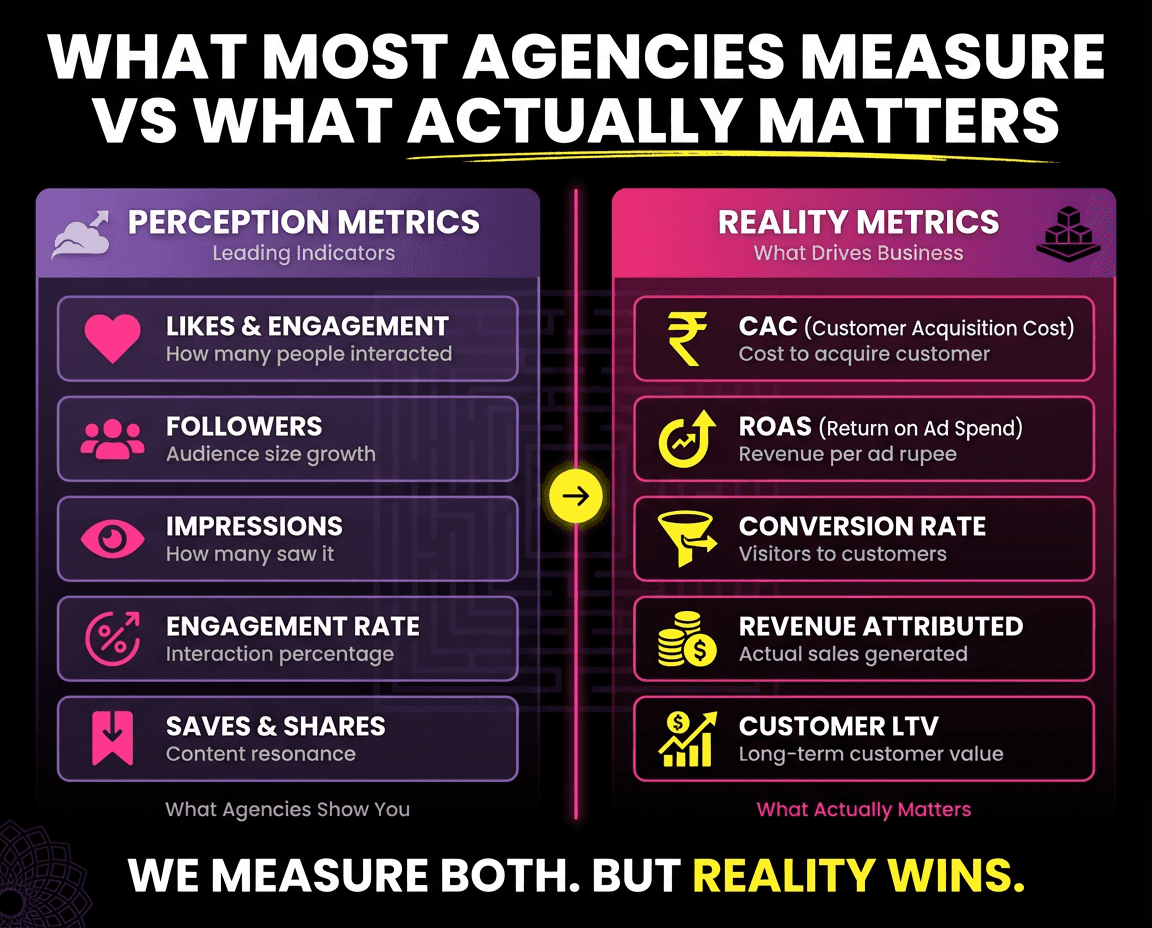
Most agencies celebrate views, likes, and followers. These are perception metrics.
We care about reality metrics.
Perception indicators include engagement, reach, saves, and sentiment. Reality indicators include CAC, ROAS, conversion rate, revenue, and lifetime value.
If content gets views but no sales, we fix the strategy. If content gets fewer likes but generates quality leads, we double down.
Illusion is the tool. Business outcomes are the goal.
Related read: Performance Marketing for Brands Scaling from ₹50L to ₹2Cr
Good Marketing Is Honest Illusion
Honest illusion means creating desire for something that genuinely delivers.
Take Apple. The marketing creates aspiration. The illusion suggests creativity and innovation. But the product experience backs it up.
• The design is genuinely thoughtful.
• The ecosystem works smoothly.
• The user experience feels superior.
The perception matches reality.
The same applies to Indian D2C brands like Minimalist or Dot & Key. Their marketing builds aspiration around clear, glowing skin. But the products use quality ingredients, transparent formulations, and real science.
That is honest illusion. You amplify the truth in a way that makes people care.
Research supports this. Gallup’s research shows that around 70% of purchasing decisions are emotional. Harvard professor Gerald Zaltman’s work shows that 95% of decisions happen subconsciously.
Marketing works in the emotional and subconscious space. That is Moh Maaya. The danger comes only when perception and reality do not match.
When Illusion Becomes Deceptive
Deceptive illusion happens when marketing promises something the product cannot deliver.
A real example from the Indian D2C space involved a fashion brand advertising premium quality with beautiful visuals. Customers received thin fabric, poor stitching, and mismatched colors.
They spent heavily on ads, generated orders, faced massive returns, and shut down within six months.
The illusion was strong. The reality was weak.
The cost of this kind of marketing is brutal. Emplifi reports that most consumers abandon a brand after just one or two bad experiences. Qualtrics reports trillions in global revenue lost due to poor customer experiences.
Common deceptive tactics include:
• Artificial scarcity
• Fake urgency
• Undisclosed paid reviews
• Misleading product visuals
• Exaggerated claims with no proof
These tactics work briefly, then destroy trust.
How We Apply This Philosophy at Moh Maaya Media
We do not pretend we are not shaping perception. We are. That is the job.
But we start with truth.
When a client asks for authentic content, we explain what that actually means. We will design how people perceive your brand. We will create desire. But we will only amplify what is real.
Social media is always a performance. Camera angle matters. Lighting matters. Story matters. That does not make it fake. It makes it intentional.
If your brand genuinely uses AI automation, we showcase it. We make it exciting. But the truth comes first.
Related read: The AI Powered Marketing Stack We Actually Use
We Build Illusion on Strategy, Not Fantasy
Every engagement starts with one question: what is genuinely true about this brand that is worth amplifying?
We ask things like:
• What problem do you solve better than others?
• What do your happiest customers say?
• What operational advantage do you really have?
• What values do you actually live by?
We do not invent positioning. We do not fake premium. We do not borrow sustainability claims. We do not promise what cannot be delivered.
Because illusion built on lies collapses the moment a customer buys.
We Measure Reality, Not Just Perception
Most agencies celebrate views, likes, and followers. These are perception metrics.
We care about reality metrics.
Perception indicators include engagement, reach, saves, and sentiment. Reality indicators include CAC, ROAS, conversion rate, revenue, and lifetime value.
If content gets views but no sales, we fix the strategy. If content gets fewer likes but generates quality leads, we double down.
Illusion is the tool. Business outcomes are the goal.
Related read: Performance Marketing for Brands Scaling from ₹50L to ₹2Cr
What This Means for Founder Led D2C Brands
If you are building a D2C brand between ₹50L and ₹2Cr, you need agencies that admit the game exists.
Red flags include:
• Only creative talk with no business metrics
• Buzzwords without frameworks
• Success measured only by followers
• Beautiful work with no results explanation
Green flags include:
• Clear philosophy
• Business first questions
• CAC and ROAS discussions
• Transparency about what works
Ask agencies about their philosophy. The good ones will answer clearly.
The Moh Maaya Test
Ask yourself three things:
Does your brand promise match customer experience?
Are you building desire for something real?
Would you be proud if customers saw behind the curtain?
If the answer is yes, you are building honest Moh Maaya.
Final Thoughts
Marketing has always been about perception. Humans buy stories before specifications.
Emotion drives decisions. That is not manipulation. That is psychology.
At Moh Maaya Media, we accept this truth.
• We acknowledge perception
• We build illusion rooted in reality
• We measure business outcomes
• We amplify what is genuinely true
That is honest Moh Maaya.
If you want to work with an agency that plays the game honestly, let’s talk.
What This Means for Founder Led D2C Brands
If you are building a D2C brand between ₹50L and ₹2Cr, you need agencies that admit the game exists.
Red flags include:
• Only creative talk with no business metrics
• Buzzwords without frameworks
• Success measured only by followers
• Beautiful work with no results explanation
Green flags include:
• Clear philosophy
• Business first questions
• CAC and ROAS discussions
• Transparency about what works
Ask agencies about their philosophy. The good ones will answer clearly.
The Moh Maaya Test
Ask yourself three things:
Does your brand promise match customer experience?
Are you building desire for something real?
Would you be proud if customers saw behind the curtain?
If the answer is yes, you are building honest Moh Maaya.
Final Thoughts
Marketing has always been about perception. Humans buy stories before specifications.
Emotion drives decisions. That is not manipulation. That is psychology.
At Moh Maaya Media, we accept this truth.
• We acknowledge perception
• We build illusion rooted in reality
• We measure business outcomes
• We amplify what is genuinely true
That is honest Moh Maaya.
If you want to work with an agency that plays the game honestly, let’s talk.
Sources:
• https://emplifi.io/press/
• https://www.gallup.com/workplace/398954/customer-brand-preference-decisions-gallup-principle.aspx
• https://www.xminstitute.com/blog/trillion-sales-at-risk-2024/
• https://www.researchandmetric.com/blog/consumer-psychology-buying-decisions-emotional-factors/
Books referenced:
• Zaltman, Gerald. How Customers Think. Harvard Business School Press.
Sources:
• https://emplifi.io/press/
• https://www.gallup.com/workplace/398954/customer-brand-preference-decisions-gallup-principle.aspx
• https://www.xminstitute.com/blog/trillion-sales-at-risk-2024/
• https://www.researchandmetric.com/blog/consumer-psychology-buying-decisions-emotional-factors/
Books referenced:
• Zaltman, Gerald. How Customers Think. Harvard Business School Press.
More Insights
More Insights


Let's Work Together
Have a project in mind? We’d love to hear about it. Let’s create something great together!
Let's Work Together
Have a project in mind? We’d love to hear about it. Let’s create something great together!
Let's Work Together
Have a project in mind? We’d love to hear about it. Let’s create something great together!