How We Build Social Media Systems
How We Build Social Media Systems
How We Build Social Media Systems
A practical breakdown of how to build social media systems using batching, repurposing, and content supply chains instead of relying on basic content calendars.
A practical breakdown of how to build social media systems using batching, repurposing, and content supply chains instead of relying on basic content calendars.
Not Just Content Calendars
Most social media management today is just expensive scheduling.
An agency sends a clean looking calendar with 12 posts planned for the month. Some nice graphics. A few motivational quotes. Promises of consistent presence and increased engagement.
Three months later, you are paying 25,000-30,000 rupees every month for content that feels generic. The graphics could belong to any brand. The captions sound like they were written by someone who has never actually used your product. And most importantly, social media still is not driving leads or sales.
What is missing is not more posts.
It is a system.
Most agencies treat social media as 12 separate tasks every month. Post on Monday. Post on Wednesday. Post on Friday. Repeat.
That is not social media management. That is glorified scheduling.
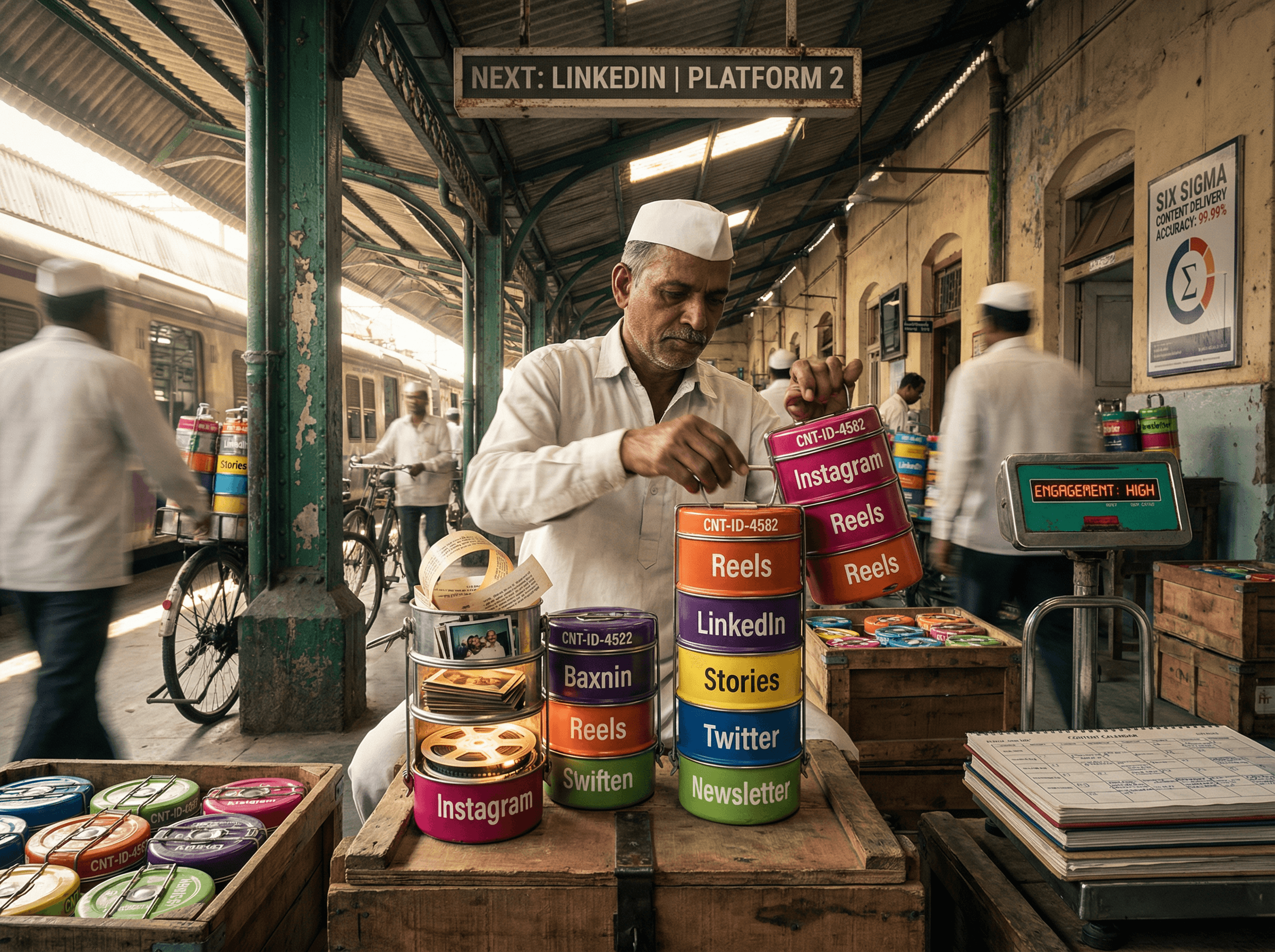
Real social media management is building a content supply chain that can turn one strong idea into 40 plus pieces of content, work across multiple accounts, and actually support business growth.
This article shows exactly how we do that. The batching systems. The repurposing frameworks. The real time breakdowns. No fluff.
Why Content Calendars Alone Fail
Let us be honest about what most agencies actually deliver.
The usual output looks like this:
• 12 feed posts per month
• A few stories every week
• Template based captions
• Canva graphics
• Posts published on schedule
What is missing is the engine behind it.
Where do these posts come from?
Who creates them?
What happens when ideas dry up?
Most teams end up recycling the same formats. Motivation on Monday. Wisdom on Wednesday. Friday feelings. The feed becomes predictable, boring, and ineffective.
The real problem is this. Agencies think in posts. Not systems.
They focus on filling the calendar instead of building a process that makes content creation repeatable and aligned with business goals.
Content Supply Chain vs Content Calendar
This shift changes everything.
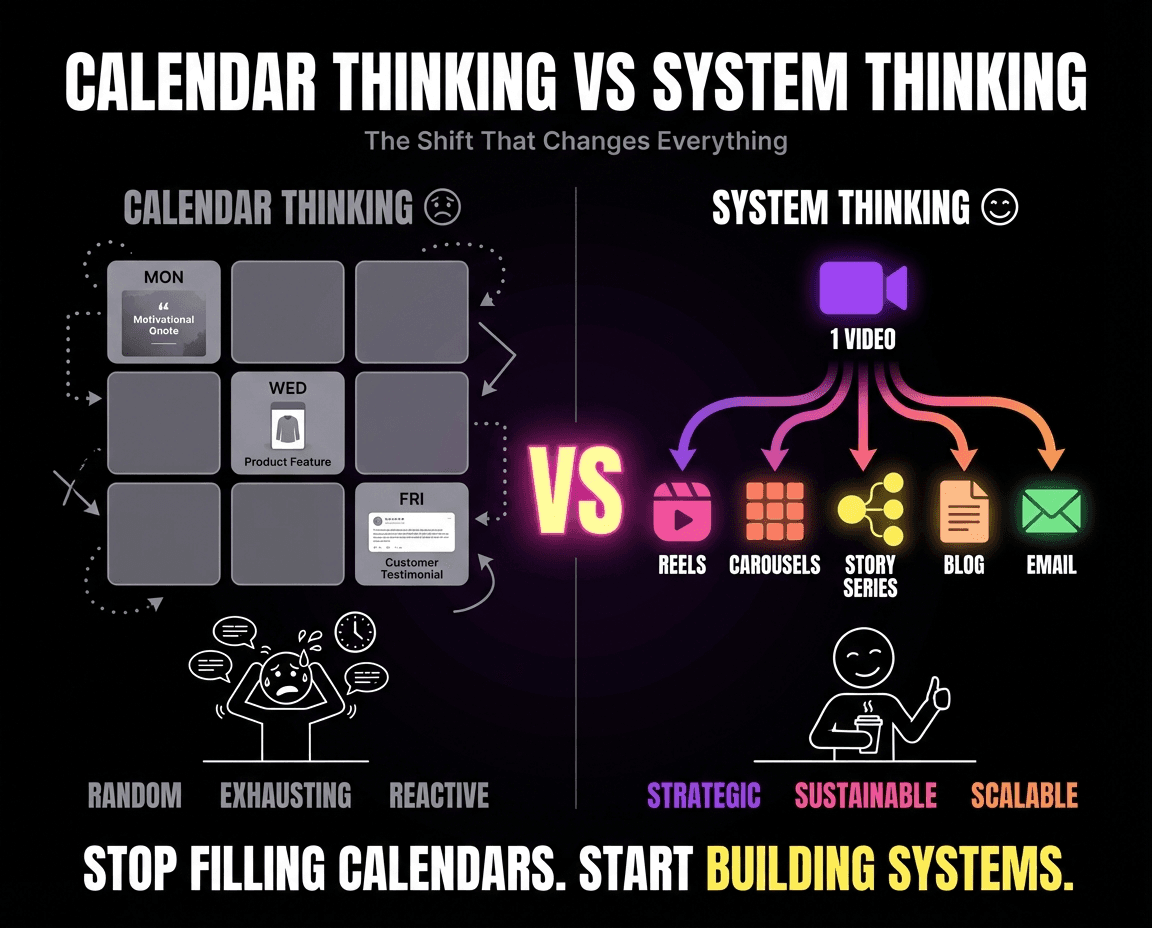
Calendar Thinking
Monday is a quote.
Wednesday is a product post.
Friday is a testimonial.
Repeat and hope it works.
This approach requires fresh ideation for every post. Content feels disconnected. Teams burn out. There is no strategic thread.
Supply Chain Thinking
One core piece of content
A repurposing process
Multiple outputs across platforms
One focused creative session produces weeks of content. Everything connects to a central theme. The system runs even when the founder is not involved daily.
Research shows repurposing saves 60-80% of content creation time compared to creating everything from scratch. Yet most brands still post one off ideas and wonder why they feel exhausted.
Calendars show what you post.
Systems decide how content is produced.
Strong systems are sustainable, scalable, strategic, and measurable.
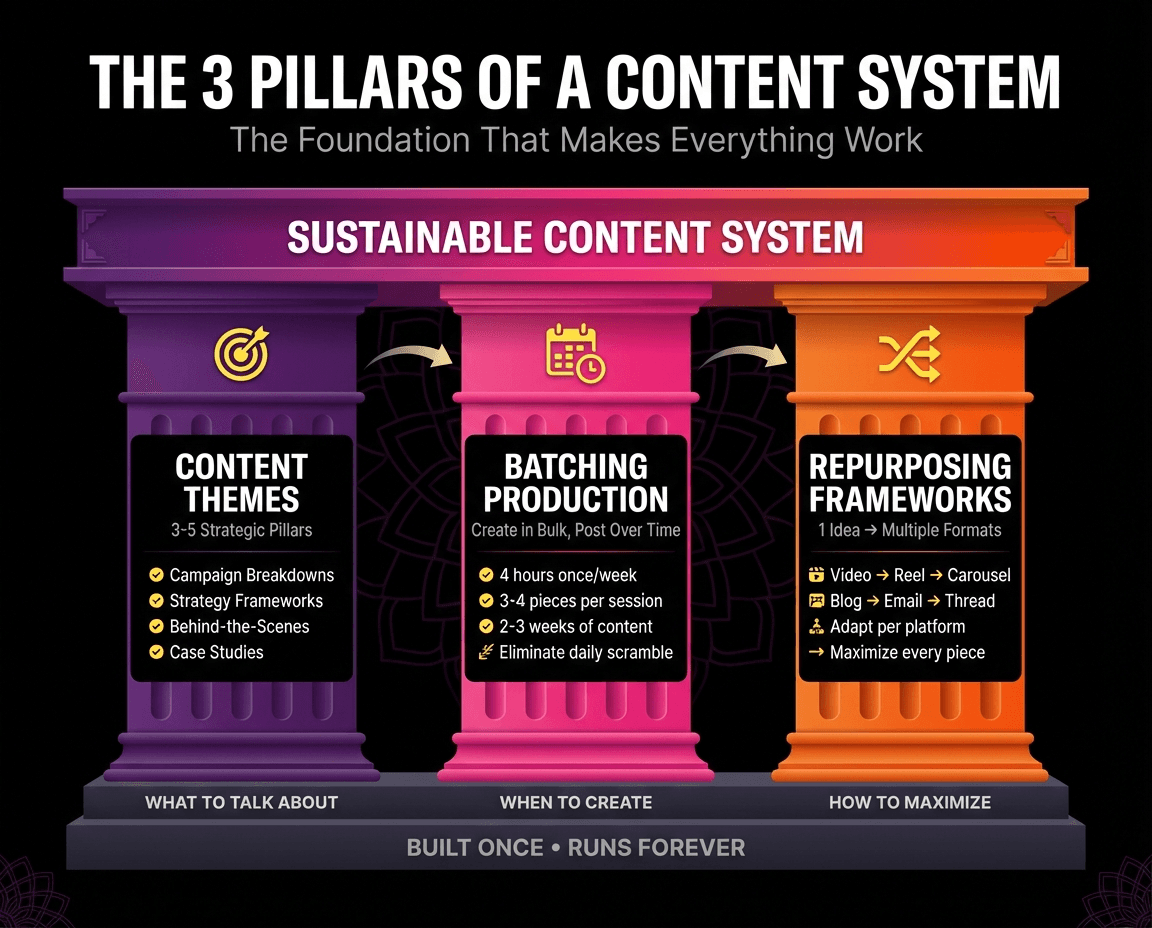
The Three Pillars of a Social Media System
Pillar One
Content Themes Not Random Ideas
Stop posting whatever comes to mind. Choose three to five content themes tied to your business goals.
Related read: Our Marketing Agency Philosophy: Why We Named Ourselves Moh Maaya
For Moh Maaya, our themes include:
• Campaign breakdowns
• Marketing frameworks
• Behind the scenes agency work
• Client results
• Clear takes on marketing trends
For a D2C skincare brand, themes could be:
• Ingredient education
• Before and after results
• Customer stories
• Routine building guides
• Myth busting content
When themes are clear, ideation becomes easy. You are choosing from buckets, not inventing ideas every time.
Experts recommend four to five themes to maintain consistency and reduce decision fatigue.
Not Just Content Calendars
Most social media management today is just expensive scheduling.
An agency sends a clean looking calendar with 12 posts planned for the month. Some nice graphics. A few motivational quotes. Promises of consistent presence and increased engagement.
Three months later, you are paying 25,000-30,000 rupees every month for content that feels generic. The graphics could belong to any brand. The captions sound like they were written by someone who has never actually used your product. And most importantly, social media still is not driving leads or sales.
What is missing is not more posts.
It is a system.
Most agencies treat social media as 12 separate tasks every month. Post on Monday. Post on Wednesday. Post on Friday. Repeat.
That is not social media management. That is glorified scheduling.
Real social media management is building a content supply chain that can turn one strong idea into 40 plus pieces of content, work across multiple accounts, and actually support business growth.
This article shows exactly how we do that. The batching systems. The repurposing frameworks. The real time breakdowns. No fluff.
Why Content Calendars Alone Fail
Let us be honest about what most agencies actually deliver.
The usual output looks like this:
• 12 feed posts per month
• A few stories every week
• Template based captions
• Canva graphics
• Posts published on schedule
What is missing is the engine behind it.
Where do these posts come from?
Who creates them?
What happens when ideas dry up?
Most teams end up recycling the same formats. Motivation on Monday. Wisdom on Wednesday. Friday feelings. The feed becomes predictable, boring, and ineffective.
The real problem is this. Agencies think in posts. Not systems.
They focus on filling the calendar instead of building a process that makes content creation repeatable and aligned with business goals.
Content Supply Chain vs Content Calendar
This shift changes everything.
Calendar Thinking
Monday is a quote.
Wednesday is a product post.
Friday is a testimonial.
Repeat and hope it works.
This approach requires fresh ideation for every post. Content feels disconnected. Teams burn out. There is no strategic thread.
Supply Chain Thinking
One core piece of content
A repurposing process
Multiple outputs across platforms
One focused creative session produces weeks of content. Everything connects to a central theme. The system runs even when the founder is not involved daily.
Research shows repurposing saves 60-80% of content creation time compared to creating everything from scratch. Yet most brands still post one off ideas and wonder why they feel exhausted.
Calendars show what you post.
Systems decide how content is produced.
Strong systems are sustainable, scalable, strategic, and measurable.
The Three Pillars of a Social Media System
Pillar One
Content Themes Not Random Ideas
Stop posting whatever comes to mind. Choose three to five content themes tied to your business goals.
Related read: Our Marketing Agency Philosophy: Why We Named Ourselves Moh Maaya
For Moh Maaya, our themes include:
• Campaign breakdowns
• Marketing frameworks
• Behind the scenes agency work
• Client results
• Clear takes on marketing trends
For a D2C skincare brand, themes could be:
• Ingredient education
• Before and after results
• Customer stories
• Routine building guides
• Myth busting content
When themes are clear, ideation becomes easy. You are choosing from buckets, not inventing ideas every time.
Experts recommend four to five themes to maintain consistency and reduce decision fatigue.
Pillar Two
Batching Production
Daily creation is exhausting and inefficient.
Switching constantly between thinking and execution kills quality.
Batching solves this.
Batching means creating content in focused sessions, then scheduling it for weeks ahead.
The batching framework we use:
• Block four hours weekly.
• Record multiple pieces at once.
• Edit in one session.
• Write captions together.
• Schedule everything together.
Real Moh Maaya example:
Monday morning we record two campaign breakdowns.
Monday afternoon we edit and create carousels.
Tuesday we write captions.
Wednesday we schedule.
Five hours of work gives us three weeks of content.
Batching improves focus, reduces burnout, and increases quality because you stay in one mental mode instead of constantly switching.
Related read: Performance Marketing for Brands Scaling from ₹50L to ₹2Cr
Pillar Three
Repurposing Frameworks
Stop creating new content for every platform.
One strong idea can live everywhere if adapted correctly.
The repurposing flow:
One anchor piece such as a video or blog
Extract key insights
Adapt per platform and per account
One video becomes reels, carousels, stories, blog posts, emails, and LinkedIn content.
One piece of work can generate 12-15 outputs in three to four hours.
Studies show most high performing teams extract 5-7 assets from one long form piece. That is where efficiency comes from.
Different audiences consume content differently. Repurposing meets people where they already are.
Related read: The AI Powered Marketing Stack We Actually Use
How We Run Three Accounts Without Burning Out
We manage:
• Moh Maaya Media for agency positioning.
• unmuted.ankita for messaging and content strategy.
• monish.builds for growth systems.
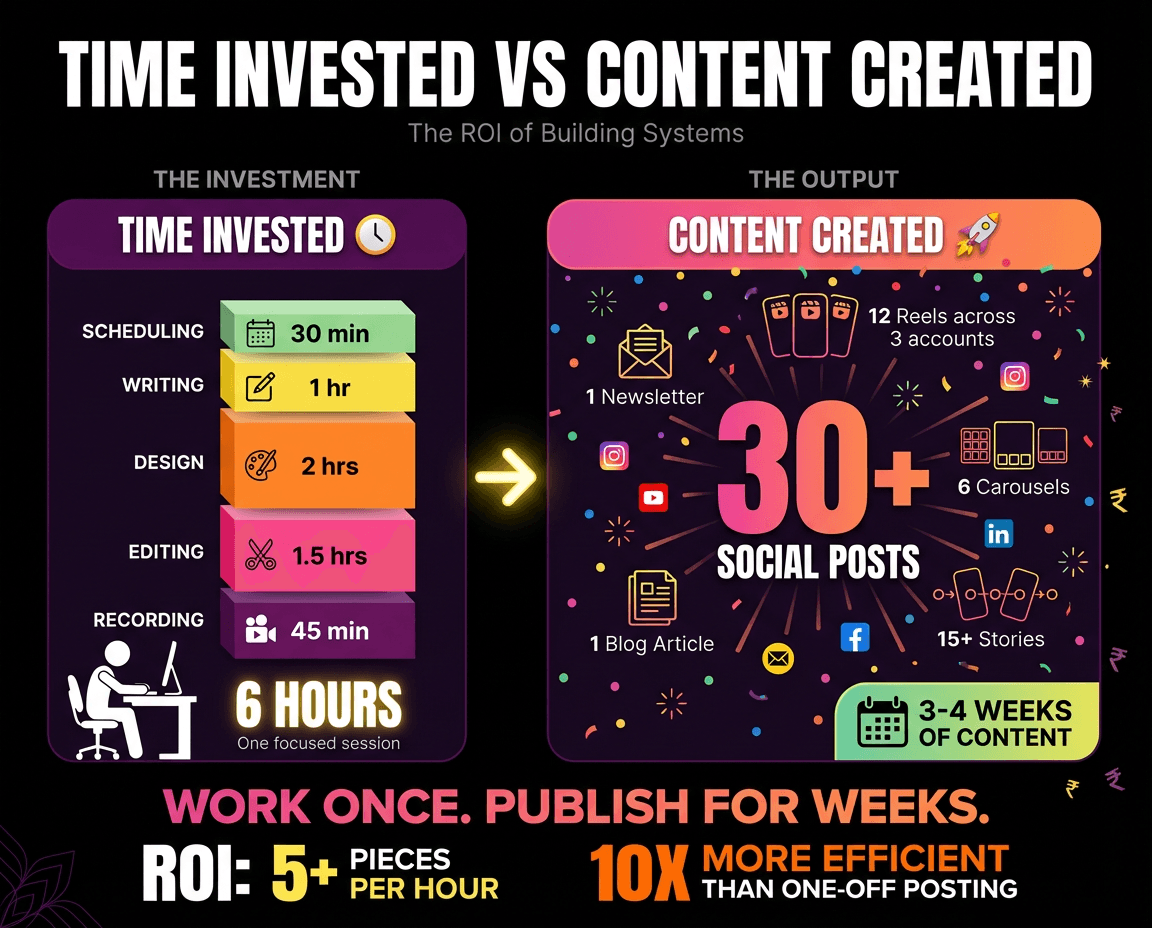
One campaign breakdown video fuels all three accounts through structured adaptation.
The process spans four weeks. Creation. Repurposing. Adaptation. Distribution.
Six hours of focused work creates over thirty content pieces, one blog, one email newsletter, and weeks of pipeline.
This works because the system is clear.
What Most Agencies Skip
Engagement Strategy
Posting is not social media management.
Real management includes responding to comments, handling DMs, engaging with relevant accounts, and monitoring conversations.
Daily engagement of thirty minutes improves reach, conversions, and community trust.
DMs convert far better than comments. Most brands ignore this.
Performance Tracking
Likes are vanity metrics.
We track saves, shares, comments, leads, and sales attribution.
Weekly reviews identify what works. Monthly reviews connect content to revenue.
If social media is not tied to business outcomes, it is just noise.
Pillar Two
Batching Production
Daily creation is exhausting and inefficient.
Switching constantly between thinking and execution kills quality.
Batching solves this.
Batching means creating content in focused sessions, then scheduling it for weeks ahead.
The batching framework we use:
• Block four hours weekly.
• Record multiple pieces at once.
• Edit in one session.
• Write captions together.
• Schedule everything together.
Real Moh Maaya example:
Monday morning we record two campaign breakdowns.
Monday afternoon we edit and create carousels.
Tuesday we write captions.
Wednesday we schedule.
Five hours of work gives us three weeks of content.
Batching improves focus, reduces burnout, and increases quality because you stay in one mental mode instead of constantly switching.
Related read: Performance Marketing for Brands Scaling from ₹50L to ₹2Cr
Pillar Three
Repurposing Frameworks
Stop creating new content for every platform.
One strong idea can live everywhere if adapted correctly.
The repurposing flow:
One anchor piece such as a video or blog
Extract key insights
Adapt per platform and per account
One video becomes reels, carousels, stories, blog posts, emails, and LinkedIn content.
One piece of work can generate 12-15 outputs in three to four hours.
Studies show most high performing teams extract 5-7 assets from one long form piece. That is where efficiency comes from.
Different audiences consume content differently. Repurposing meets people where they already are.
Related read: The AI Powered Marketing Stack We Actually Use
How We Run Three Accounts Without Burning Out
We manage:
• Moh Maaya Media for agency positioning.
• unmuted.ankita for messaging and content strategy.
• monish.builds for growth systems.
One campaign breakdown video fuels all three accounts through structured adaptation.
The process spans four weeks. Creation. Repurposing. Adaptation. Distribution.
Six hours of focused work creates over thirty content pieces, one blog, one email newsletter, and weeks of pipeline.
This works because the system is clear.
What Most Agencies Skip
Engagement Strategy
Posting is not social media management.
Real management includes responding to comments, handling DMs, engaging with relevant accounts, and monitoring conversations.
Daily engagement of thirty minutes improves reach, conversions, and community trust.
DMs convert far better than comments. Most brands ignore this.
Performance Tracking
Likes are vanity metrics.
We track saves, shares, comments, leads, and sales attribution.
Weekly reviews identify what works. Monthly reviews connect content to revenue.
If social media is not tied to business outcomes, it is just noise.
Content Libraries
Winning content should never be lost.
We maintain a content bank that stores successful hooks, angles, formats, and results. When ideas are needed, we adapt proven concepts instead of starting from zero.
Systems Do Not Kill Creativity
They Protect It
Systems do not remove personality. They protect it.
They free up mental space so creators can focus on being human, thoughtful, and responsive instead of exhausted.
What This Costs
Founder led setup costs time and minimal tools.
Agency systems cost more but remove founder bottlenecks.
In house teams offer control but increase fixed costs.
ROI is determined by the system, not the tool stack.
A founder with a system beats an expensive agency without one every time.
Calendar Thinking vs System Thinking
Calendar thinking asks what to post tomorrow.
System thinking asks how to produce consistently.
Most brands fail because they solve the wrong problem.
Winning brands build the system once, then execute repeatedly, refine with data, and scale without burnout.
That is how we manage multiple accounts, serve clients, and still produce deep content like this.
Content Libraries
Winning content should never be lost.
We maintain a content bank that stores successful hooks, angles, formats, and results. When ideas are needed, we adapt proven concepts instead of starting from zero.
Systems Do Not Kill Creativity
They Protect It
Systems do not remove personality. They protect it.
They free up mental space so creators can focus on being human, thoughtful, and responsive instead of exhausted.
What This Costs
Founder led setup costs time and minimal tools.
Agency systems cost more but remove founder bottlenecks.
In house teams offer control but increase fixed costs.
ROI is determined by the system, not the tool stack.
A founder with a system beats an expensive agency without one every time.
Calendar Thinking vs System Thinking
Calendar thinking asks what to post tomorrow.
System thinking asks how to produce consistently.
Most brands fail because they solve the wrong problem.
Winning brands build the system once, then execute repeatedly, refine with data, and scale without burnout.
That is how we manage multiple accounts, serve clients, and still produce deep content like this.
Sources:
• https://www.cloudpresent.co/blog/the-complete-guide-to-repurposing-content-maximize-your-marketing-roi-in-2025
• https://hostadvice.com/blog/digital-marketing/content-marketing/content-batching/
• https://buffer.com/resources/content-batching/
• https://www.womenconquerbiz.com/ultimate-guide-to-batching-content-for-efficiency/
• https://sociallyin.com/resources/social-media-strategy-for-d2c-brands/
Sources:
• https://www.cloudpresent.co/blog/the-complete-guide-to-repurposing-content-maximize-your-marketing-roi-in-2025
• https://hostadvice.com/blog/digital-marketing/content-marketing/content-batching/
• https://buffer.com/resources/content-batching/
• https://www.womenconquerbiz.com/ultimate-guide-to-batching-content-for-efficiency/
• https://sociallyin.com/resources/social-media-strategy-for-d2c-brands/
More Insights
More Insights


Let's Work Together
Have a project in mind? We’d love to hear about it. Let’s create something great together!
Let's Work Together
Have a project in mind? We’d love to hear about it. Let’s create something great together!
Let's Work Together
Have a project in mind? We’d love to hear about it. Let’s create something great together!